
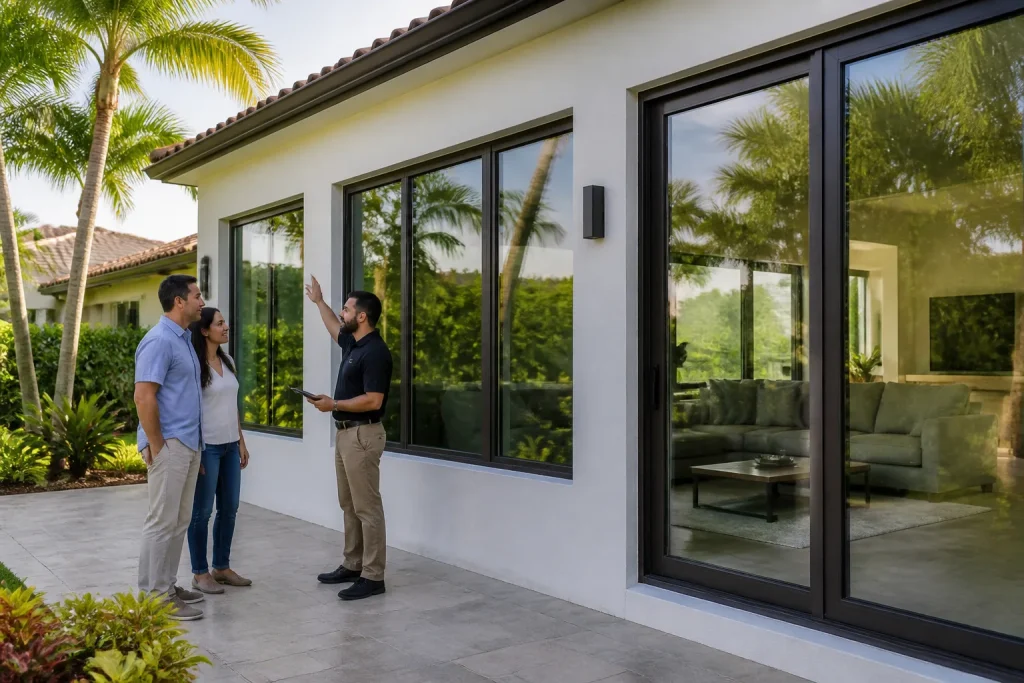
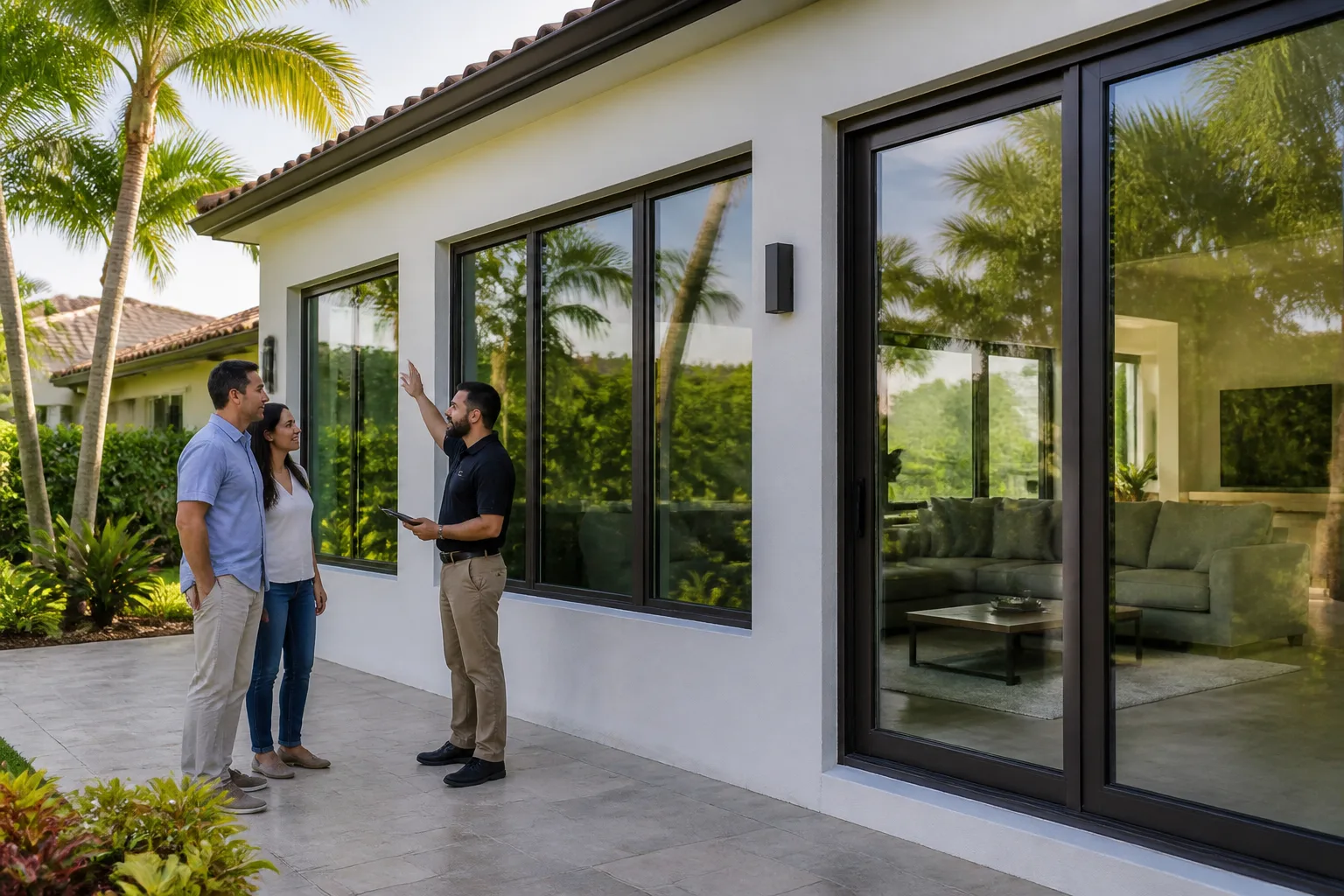
How to Choose the Right Windows & Doors Company in Plantation
Choosing the right window and door company in Plantation comes down to four documents: a current Florida contractor license verification, written manufacturer authorization, a warranty registration promise in writing, and a clean Broward County permit history. Most contractors will talk around all four. Ask for them before anyone measures an opening, and the list of candidates shortens fast. If you’d rather skip the homework, call (772) 577-2915 and we’ll walk you through what we’d want to see if we were hiring from outside our own shop.
A contractor with a clean truck, a polished estimate, and no verifiable Broward County license history closed more than 200 jobs in South Florida last year. The tell sat on page one of a public database most homeowners never open. This guide gives you the exact checklist we use when friends in Plantation ask us to vet a bid they’re holding.
Key Takeaways
- Check the DBPR license status before you take a second meeting. “Active” is not the only status that matters.
- Ask whether the installer is a registered, authorized dealer for the specific window brand on the quote. Licensed and authorized are two separate things.
- Get both warranty layers in writing, in your name, with durations stated. A vague answer is the answer.
- Pull the permit history. Repeated inspection failures tell you more than any online review.
- Decades of local service in Plantation means something practical: someone answers the phone when the warranty matters.
Step One: Pull the Florida DBPR License Before Anything Else
Every legitimate window and door contractor working in Plantation carries a Florida state contractor’s license issued through the Department of Business and Professional Regulation, known as DBPR. The lookup takes under three minutes. Go to the DBPR website, enter the company name or the license number printed on the business card, and read the status column carefully.
“Active” is what you want to see. But a license can read “Active” with open complaints pending, so scroll a little further. Look at the discipline section and check for administrative actions. What you really don’t want is “Inactive,” “Delinquent,” or “Revoked.” Here’s what an inactive license costs you if work goes wrong: the company’s insurance carrier will often deny a claim tied to work performed without an active license, and any lawsuit against the contractor becomes harder to pursue because the bond that should stand behind the work isn’t in force. You are, in practical terms, uninsured against their mistakes.
We’ve watched homeowners in Plantation show up to consultations holding a printed quote from a company whose license lapsed eighteen months earlier. The quote looked professional. The company didn’t. Two minutes on the DBPR site would have ended that conversation before it began.
When to call a pro: if reading a DBPR record leaves you uncertain about what a status means, call the company and ask them to explain it. A straight answer in plain language is a reasonable expectation. A defensive one is not.
Step Two: Ask About Manufacturer Authorization Separately from Licensing
Here’s a distinction almost no one explains: a contractor can be fully licensed by the state of Florida and still not be an authorized installer for the window brand on the estimate. Those are separate credentials, and conflating them is how homeowners end up with a voided factory warranty.
Manufacturers like Andersen, Pella, Marvin, and PGT maintain authorized dealer and installer programs. Being authorized means the company has trained on that specific product line, has access to current installation protocols, and is recognized by the manufacturer as qualified to install the product under warranty. Here’s the practical problem: many contractors buy product through third-party supply houses and install it without ever registering as an authorized installer. The homeowner receives a window that carries a factory warranty, but if the install method doesn’t match the manufacturer’s published requirements, the warranty claim gets rejected. The homeowner finds this out five years later when the seal fails or the frame warps.
TruePane is an authorized installer for more than a dozen manufacturer lines, and when we quote, we show the authorization in writing. We also quote manufacturer lines side by side on paper, so a homeowner in Plantation can see what they’re buying from two or three brands, not just whichever brand earns us the highest margin. We’ve installed PGT and CGI impact lines across Broward County, and we pull a quote for ES Windows when the house calls for a fully custom frame. The brand should fit the opening and the exposure, not the other way around.
Step Three: The Warranty Question That Eliminates Most Bids
Before signing anything, ask the contractor this exact sentence: “Will you register both the manufacturer warranty and the installation warranty in my name, in writing, with the duration stated?”
Listen to the answer. A specific yes, with a description of what gets registered and when, is what you want to hear. We register both warranty layers before the truck leaves the driveway. It’s called The Keystone Standard, and it exists because Dale Kessler spent years watching homeowners chase warranty paperwork through companies that stopped answering the phone the month after the job closed. The manufacturer warranty gets registered with the factory in your name. The workmanship warranty gets stated in writing with its duration, which for us is the 90-Day Done Right Promise. If something is not done right, we make it right. No paperwork fights, no arguing, no fine print that quietly covers neither layer.
A vague answer, like “oh, we handle all that,” or “the factory handles the warranty,” is itself the answer. It means the registration will not happen, and the duration will not be stated, and five years from now you’ll be standing in your Plantation living room with a fogged pane and a phone number that doesn’t ring.
We pulled one out of a house over in Plantation Palms a few years back. A double slider from another contractor, installed two years prior, seal already failed. The homeowner called the manufacturer. The manufacturer said the installer wasn’t authorized and the warranty didn’t apply. The homeowner called the installer. The installer’s phone went to a vape shop. The homeowner called us. The opening had to be re-framed because the original install was so far out of true that a new unit wouldn’t seat. False economy is the polite way to put it.
Step Four: Check the Permit History Through Broward County
Broward County maintains a public records portal where you can pull permit history for any address. Before you hire a window and door company in Plantation, ask for a few addresses of recent jobs, then look up those permits yourself. You’re looking for two things: permits that were pulled at all, and inspection results that came back clean.
A company that replaces windows without pulling permits is telling you something about how they’ll handle your job. Unpermitted work puts you at risk when you sell the house, and it can trigger problems with your homeowners insurance if a window fails during a storm and the claim investigation finds unpermitted work. In Broward County, impact window installations especially require permitting and inspection, because the product is structural when a hurricane hits.
Repeated inspection failures are a red flag you can’t get from an online review. If the same company’s permits show multiple correction notices or re-inspections, the work isn’t passing the first time. Some failures are ordinary, especially on large jobs. A pattern of them isn’t. Open permits from prior jobs are worse; an open permit means the job was never closed out, which usually means the company walked away before the final inspection.
Related services in Plantation: when you’re comparing companies, it helps to understand what a proper install involves. Our Window Installation in Plantation page explains how we measure, order, and set a window, and our Window Replacement in Plantation page covers what’s involved when old frames come out.
Step Five: Look for Roots, Not a Service Area
There’s a difference between a company that has served Plantation for decades and a company that lists Plantation as a service area on a lead-generation website. The distinction matters most when the warranty claim comes due five years from now.
A company with deep roots in the area answers the phone. Not a voicemail tree, not a callback form, not a regional call center routing you to a technician in a different county. A live person answers 24 hours a day, seven days a week. That’s how we run TruePane, and it’s why people who have lived in Plantation for twenty years tend to find us the second time around, after the first company vanished with the warranty. We hire local apprentices and train them into journeymen because we plan to be in town in thirty years, and we sponsor county fairs and church roof funds in Broward County because we’re part of the county, not a franchise playbook that can relocate the call center to another state.
When you call a Plantation company with deep roots, you’re calling someone who has likely driven past your neighborhood for a decade and knows which subdivisions in Plantation Acres carry impact requirements and which blocks in Plantation Isles fight wind-driven rain against the east-facing windows. That local knowledge is not a marketing bullet. It’s the difference between ordering the right weatherproofing system and guessing.
Step Six: Read the Quote the Way an Accountant Would
The estimate itself is a document worth studying. A proper quote from a window and door company in Plantation should itemize the product line, the glass package, the frame material, the installation method, and the hardware. If a line just says “window, replace” without specifying the brand, the Low-E coating, the impact rating, or the U-factor, you’re not holding a quote. You’re holding a conversation starter.
Ask for fixed pricing with no surprise line items. Ask whether the team that shows up is background-checked and uniformed. Ask whether the technician measures every opening twice before ordering. We do all of that as standard practice, because out-of-true measurements create out-of-true installs, and Dale’s founding rule is on the whiteboard in our shop: if the pane is not true, the job is not done. The quote should reflect that same standard on paper before any work begins.
Don’t choose the cheapest bid in Plantation. Choose the bid that documents the most. The difference is usually a few hundred dollars up front and a warranty that exists three years from now.
The Bottom Line
Choosing a window and door company in Plantation is not about finding someone who sounds trustworthy. It’s about requesting four documents: a verified DBPR license, written manufacturer authorization, dual warranty registration with durations stated, and a clean permit history. If a contractor can’t produce all four comfortably, you have your answer. If they can, you’re looking at a short list.
If you’re in Plantation and need help sorting through bids or want a free estimate from a company that has served the area for over 42 years, call (772) 577-2915. We’ll answer the phone, come out when we say we will, and put everything in writing.
Frequently Asked Questions
How do I verify a window and door contractor’s license in Plantation?
Go to the Florida DBPR website, enter the company name or license number, and read the status column. Look for “Active” status, then check for disciplinary actions or complaints. An “Inactive,” “Delinquent,” or “Revoked” license means the company is not legally operating, and your insurance claim may be denied if something goes wrong. Call the contractor and ask for an explanation if you see anything other than a clean, active record.
Does a licensed contractor automatically have manufacturer warranty authorization?
No. A Florida contractor’s license permits the company to perform work. Manufacturer authorization is a separate credential that allows the company to install a specific brand’s product under that brand’s warranty coverage. A contractor can be fully licensed and still not be an authorized installer, which means the factory warranty on your windows could be voided by an improper install. Ask for written proof of authorization for the exact brand on the quote.
What warranty should a window and door company in Plantation offer?
A complete warranty package includes two layers: the manufacturer warranty on the product, registered in your name with the duration stated, and a workmanship warranty on the installation, also in writing. At TruePane, we register both manufacturer warranty layers before the truck leaves the driveway and back the install with our 90-Day Done Right Promise. If a contractor gives a vague answer about warranty registration, treat that as a no.
Should I check permit history before hiring a window company in Plantation?
Yes. Broward County’s public records portal lets you pull permit and inspection history for any address. Look for permits that were pulled on past jobs and inspections that passed cleanly. Repeated inspection failures or open permits are serious red flags. Unpermitted window work can complicate a future home sale and cause issues with insurance claims, especially for impact windows in a storm zone.
Written by Dale Kessler, Owner at TruePane Windows & Doors, serving Plantation since 2008.
Need Windows & Doors Help?
Call TruePane Windows & Doors - licensed & insured, here with fast after-hours help in Plantation.
(772) 577-2915